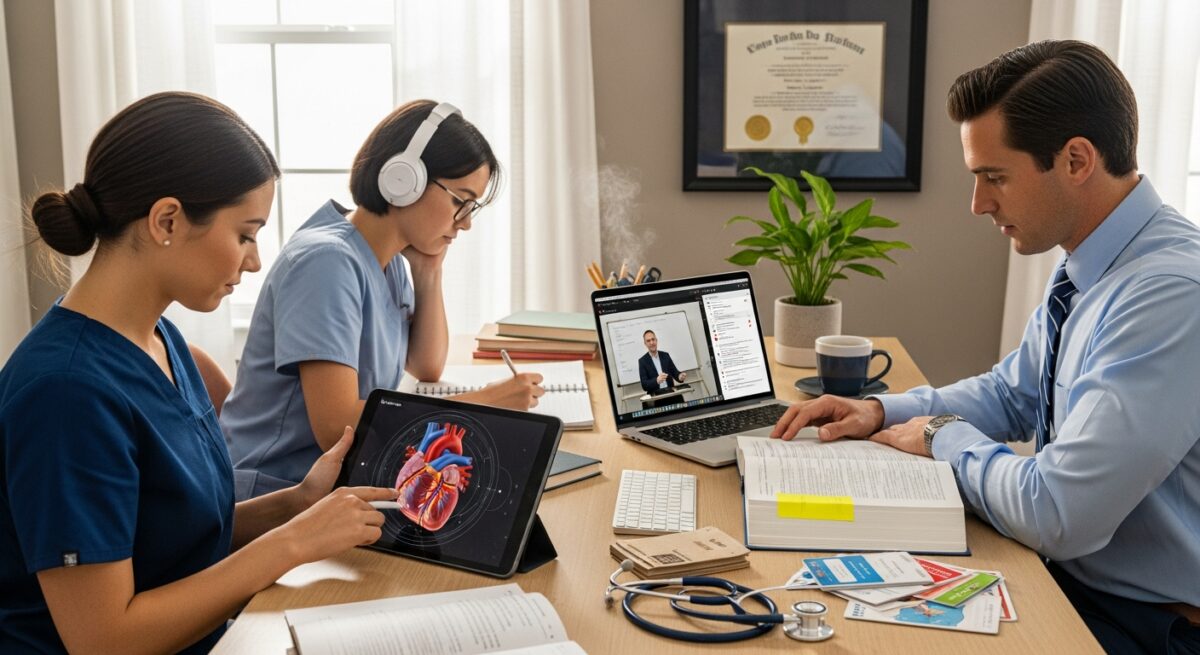
The healthcare field continues to grow at a rapid pace, and nursing remains one of the most in-demand professions worldwide. For working professionals, career changers, and adult learners, the path to a nursing career no longer requires a full-time campus commitment. A well-structured nursing courses online training and certification guide can help you navigate the many options available, from entry-level certificates to advanced degree programs. With the right online nursing classes, you can gain the skills and credentials needed to enter or advance in this rewarding field while balancing work, family, and other responsibilities.
Why Online Nursing Education Is Gaining Momentum
The shift toward nursing education online is driven by flexibility, accessibility, and the increasing quality of virtual instruction. Many accredited institutions now offer fully online or hybrid programs that allow students to complete coursework digitally while fulfilling clinical requirements at approved local healthcare facilities. This model is particularly beneficial for adult learners who need to maintain their current jobs while pursuing a degree.
For example, a licensed practical nurse (LPN) looking to become a registered nurse (RN) can enroll in an online LPN-to-RN bridge program. These programs typically offer asynchronous lectures, interactive simulations, and virtual labs that replace some traditional classroom hours. The clinical hours are then completed at a hospital or clinic near the student’s home, making the entire process more manageable. This blend of online theory and in-person practice is one of the most popular formats in modern nursing courses online.
Types of Nursing Courses and Certifications Available Online
Before enrolling in any program, it is important to understand the different levels of nursing education and how they align with your career goals. The most common online nursing courses fall into several distinct categories, each leading to a specific certification or degree. Below is a breakdown of the primary options available to prospective students.
Certified Nursing Assistant (CNA) Programs
CNA programs are the shortest and most accessible entry point into nursing. These courses typically cover basic patient care skills, infection control, and communication techniques. While the hands-on clinical component must be completed in person, the theoretical portion can often be completed online. After finishing the program, students must pass a state competency exam to become certified.
Licensed Practical Nurse (LPN) and Licensed Vocational Nurse (LVN) Programs
LPN and LVN programs are more comprehensive than CNA training and usually take about one year to complete. Online versions of these programs cover anatomy, pharmacology, and nursing fundamentals through digital lectures and assignments. Clinical rotations are arranged at local healthcare facilities. Graduates are eligible to take the NCLEX-PN exam for state licensure.
Associate Degree in Nursing (ADN) and Bachelor of Science in Nursing (BSN)
The ADN is a two-year degree that prepares students for the NCLEX-RN exam, while the BSN is a four-year degree that offers broader career opportunities and higher earning potential. Many online RN-to-BSN programs are designed for current RNs who want to upgrade their credentials. These programs focus on leadership, community health, and evidence-based practice. For those starting from scratch, some schools offer pre-licensure BSN programs with online coursework and local clinical placements.
Advanced Practice Registered Nurse (APRN) Certifications
For nurses who already hold a BSN, online master’s and doctoral programs lead to APRN roles such as nurse practitioner, clinical nurse specialist, nurse anesthetist, and nurse midwife. These programs are rigorous and require significant clinical hours, but the online format allows students to continue working while they study. Certification is granted by national boards after completing the program and passing a specialty exam.
How to Choose the Right Online Nursing Program
Selecting the right program is a critical decision that will affect your education, finances, and career trajectory. There are several factors to consider when evaluating nursing courses online. Accreditation is the most important criterion. Programs accredited by the Accreditation Commission for Education in Nursing (ACEN) or the Commission on Collegiate Nursing Education (CCNE) meet national standards and ensure that your degree will be recognized by employers and licensing boards.
Another key consideration is the program’s clinical placement support. Some online nursing classes require students to find their own clinical sites, while others have partnerships with healthcare facilities and arrange placements for you. If you are a working professional, look for programs that offer evening or weekend clinical options. Additionally, review the technology requirements. Many programs use simulation software, virtual patient scenarios, and online proctoring for exams, so a reliable computer and internet connection are essential.
Cost is also a significant factor. Tuition for online nursing programs varies widely, but many schools offer financial aid, scholarships, and payment plans. In our guide on best mathematics courses online, we discuss how to evaluate program costs and value, which can be applied to nursing programs as well. Before committing, request a detailed breakdown of all fees, including technology fees, clinical placement fees, and exam preparation costs.
The Certification Process: What to Expect After Your Nursing Courses
Completing your nursing courses online is only the first step. To practice as a nurse, you must obtain the appropriate certification or licensure. For most nursing roles, this involves passing the National Council Licensure Examination (NCLEX). The NCLEX is a standardized exam that tests the knowledge and skills necessary for safe and effective nursing practice. There are two versions: the NCLEX-PN for practical nurses and the NCLEX-RN for registered nurses.
Preparation for the NCLEX should begin during your nursing courses online. Many programs integrate NCLEX review materials and practice exams into the curriculum. After graduation, you will need to apply for licensure through your state board of nursing. The application typically includes a background check, proof of education, and payment of fees. Once approved, you can schedule your NCLEX exam at a testing center. Some states also offer alternative pathways for multistate licensure through the Nurse Licensure Compact (NLC), which allows nurses to practice in multiple states with one license.
For advanced practice certifications, such as those for nurse practitioners or clinical nurse specialists, you must pass a specialty exam offered by organizations like the American Nurses Credentialing Center (ANCC) or the American Association of Nurse Practitioners (AANP). These exams are typically taken after completing a master’s or doctoral program and require ongoing continuing education to maintain certification.
Financial Aid and Cost-Saving Strategies for Online Nursing Students
The cost of nursing education can be a barrier for many students, but there are numerous strategies to make it more affordable. Federal financial aid is available for accredited programs, and you can start by completing the Free Application for Federal Student Aid (FAFSA). Many online nursing students qualify for Pell Grants, federal student loans, and work-study programs. Additionally, some employers offer tuition reimbursement for employees pursuing nursing degrees, especially if you are already working in a healthcare setting.
Scholarships specifically for nursing students are abundant. Organizations like the American Association of Colleges of Nursing (AACN) and the National League for Nursing (NLN) offer scholarships based on academic merit, financial need, and demographic criteria. State-based scholarships and loan forgiveness programs are also available for nurses who agree to work in underserved areas after graduation. When comparing nursing courses online, be sure to factor in these potential savings.
Another cost-saving approach is to choose a community college for your ADN and then complete an online RN-to-BSN program later. This pathway can significantly reduce the total cost of your education while still leading to a BSN degree. Many employers also offer sign-on bonuses and relocation assistance for nurses, which can help offset educational expenses.
Frequently Asked Questions
Can I become a registered nurse entirely through online courses?
No, you cannot become an RN through fully online courses alone. All nursing programs require in-person clinical hours at approved healthcare facilities. However, the didactic portion of the curriculum can be completed online, and many programs arrange local clinical placements for students.
How long does it take to complete nursing courses online?
The duration depends on the program type. CNA programs can take 4 to 12 weeks, LPN programs take about 12 months, ADN programs take 2 years, and BSN programs take 4 years. Accelerated programs for students with prior degrees can be completed in 12 to 18 months.
Are online nursing degrees respected by employers?
Yes, as long as the program is accredited by a recognized accrediting body like ACEN or CCNE. Employers value the flexibility and self-discipline required to complete an online program, and many healthcare systems actively recruit graduates from reputable online nursing schools.
What technology do I need for online nursing classes?
You will need a reliable computer with a webcam, a high-speed internet connection, and access to software such as Microsoft Office. Some programs require specific simulation software or virtual lab platforms, which are typically provided by the school.
Can I work while taking nursing courses online?
Many students work while enrolled in online nursing programs, especially in part-time or flexible roles. However, the clinical hour requirements may require you to adjust your work schedule. It is important to plan ahead and communicate with your employer about your educational commitments.
For more detailed information on financial planning and university selection, you can explore the resources available at Collegedegree.education, which offers guidance on affordable education options and program comparisons.
Building a Successful Career After Certification
Once you have earned your nursing certification or degree, the next step is to launch or advance your career. Online nursing courses provide a strong foundation, but real-world experience is essential for growth. New graduates often start in hospital settings, working in medical-surgical units, emergency departments, or critical care. These environments offer valuable hands-on learning and mentorship opportunities.
Continuing education is also a key component of a nursing career. Many states require nurses to complete a certain number of continuing education units (CEUs) to renew their licenses. Online platforms offer a wide range of CEU courses, allowing you to stay current with best practices and emerging treatments. Specializing in areas such as pediatrics, oncology, or gerontology can lead to higher pay and greater job satisfaction. With the right nursing courses online training and certification guide, you can map out a long-term career plan that includes advanced degrees, leadership roles, and even teaching positions in nursing education.
The demand for qualified nurses continues to rise, driven by an aging population and advances in healthcare technology. By investing in your education through reputable online nursing classes, you position yourself for a stable, fulfilling career that makes a tangible difference in people’s lives. Whether you are just starting out or looking to take the next step, the path is clearer than ever with the resources and guidance available today.